
The real reason performance anxiety kills sex
Let's be real. Most of what we call "performance anxiety" during partnered sex isn't actually about performance. It's about the pressure to perform for someone else's benefit, not your own. That's why the anxiety hits hardest right when you should be feeling pleasure.
Your nervous system is scanning: Am I taking too long? Does this feel right? Should I be coming by now? Is my partner bored? The internal monologue becomes louder than the actual sensation, and once that happens, arousal stalls.
How anxiety shifts your body's response
When you're anxious during sex, your sympathetic nervous system (the fight-or-flight branch) takes over from the parasympathetic nervous system (the rest-and-digest branch). Blood flow redirects away from your genitals. Your pelvic floor tenses instead of relaxing. Lubrication decreases. Your brain literally cannot process pleasure signals when it's in threat-detection mode.
The irony is brutal: the harder you try to relax and perform, the less your body cooperates.
This is where lemon vibrators change the dynamic entirely. They interrupt the feedback loop by shifting the focus from "Am I doing this right?" to "What does this sensation feel like?" That's not a small shift. It's the difference between anxiety and presence.
Why clitoral vibrators specifically help with anxiety
Lemon vibrators work differently than traditional toys because of how they stimulate. Instead of the friction-based sensation of a vibrator, they use suction and pulse patterns that feel completely novel. That novelty? It commands attention in a way that disrupts the anxiety spiral.
Here's what happens neurologically. When your brain encounters a new sensation, it has to process that sensation instead of running through its anxiety checklist. You can't simultaneously wonder if you're taking too long and experience genuine curiosity about what suction at intensity level three actually feels like. Your attention goes where the sensation is.
Secondly, because lemon vibrators are designed for external clitoral stimulation, they work independently of penetration. This is huge for anxiety management. If you're being penetrated and also stimulated with a lemon vibrator, you're no longer tracking whether the penetration feels "right" or whether your body is responding "correctly." You have two separate sources of pleasure, and your nervous system can focus on one or the other, never both.
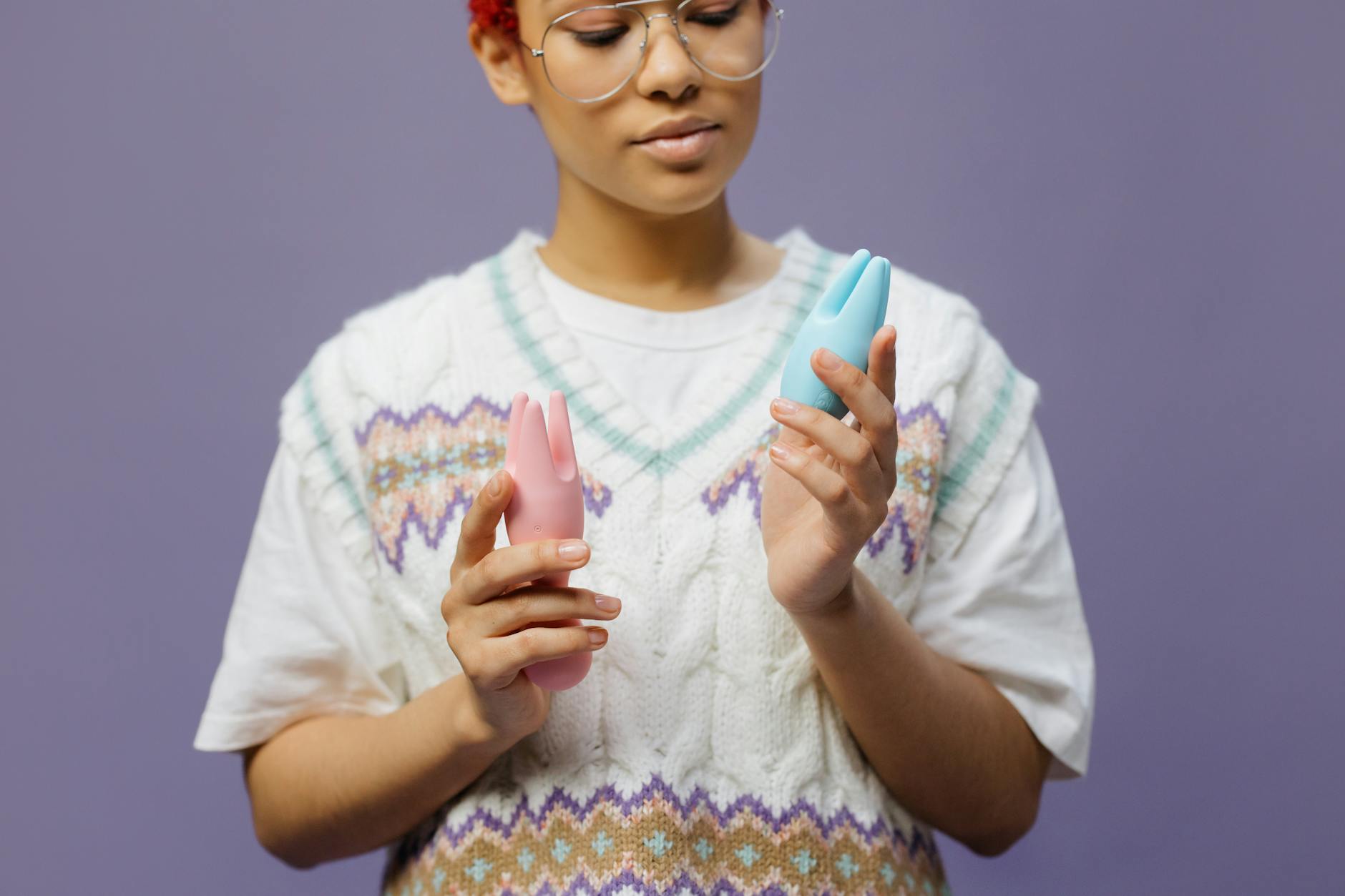
Photo by cottonbro studio on Pexels
The partner dynamic changes too
This is the part that surprises most couples. When you introduce a lemon vibrator during partnered sex, it doesn't make your partner feel inadequate. It does the opposite. Suddenly, the goal shifts from "one person has to create all the pleasure" to "we're creating pleasure together." That's less pressure on both of you.
Your partner is no longer the sole person responsible for your arousal. They become your collaborator. They can focus on their own sensation, on the intimacy of physical closeness, or on adding a different layer of stimulation. The dynamic changes from performance to partnership.
For anxious partners specifically, this is liberating. If they've been holding anxiety about whether they're doing "enough," a lemon vibrator proves the answer is yes. You're both contributing. Neither of you is failing.
How to introduce a lemon vibrator without creating more awkwardness
The conversation matters as much as the toy itself. Here's what I tell couples in my practice.
Don't frame it as a solution to a problem. Don't say "I want to use this because I'm struggling" or "I think this will help me come faster." That language embeds the anxiety right into the introduction. Instead, frame it as exploration.
"I've been curious about this," is a complete sentence. "I want to try something new together" is another. If you have a partner, involve them in the curiosity. Let them pick it out with you. Let them hold it, feel the weight of it, understand how it works. Remove the mystery.
Start with it outside of sex, actually. Use it solo first so you understand your own response. You're not proving anything to anyone. You're just gathering information about what feels good to you. Then, when you introduce it with a partner, you're not discovering it for the first time. You're sharing something you already know works.
When you first use it together, don't make it the centerpiece. Have a lemon vibrator in the room, but don't feel obligated to use it. The pressure to perform with a new toy is its own anxiety spiral. Sometimes the most powerful moment is when you're already aroused and then introduce it as a bonus, not as the main event.
What happens to anxiety over time
Here's something beautiful that I see happen with couples who stick with this. After using a clitoral vibrator together a few times, the anxiety about the vibrator itself disappears. It becomes normal. It's just part of your sexual repertoire, like any other touch or position.
But more importantly, something shifts in the dynamic. Once you've experienced pleasure that isn't dependent on you performing perfectly, you start to internalize that your body doesn't need you to be perfect. Pleasure is actually pretty accessible when you're not in your head about it.
That realization carries into sex without a vibrator too. You start to trust your body more. Your partner starts to trust that you're in it for the sensation, not the performance. The anxiety doesn't evaporate, but it loses its grip.
The physical comfort piece
One more thing that helps with anxiety. Lemon vibrators are designed with comfort in mind. They're smaller, they're ergonomic, and they're made from body-safe silicone. There's no discomfort masquerading as pleasure, which means your nervous system doesn't have to filter out pain signals while also trying to feel pleasure.
That reduction in physical uncertainty alone eases anxiety. You're not lying there wondering if something's about to hurt. You know what you're getting because the toy is predictable. Your nervous system can relax a little.
People also ask
How do I bring up using a vibrator with my partner without making them feel replaced?
Involve them from the start. Make it a joint choice, not something you're doing to fix yourself. Most partners are relieved to learn that their job isn't to create all the pleasure. Once that pressure lifts, many people actually enjoy partnered sex more. Frame it as "I found something that feels amazing and I want to share that with you," not "I need this because you're not enough."
Can lemon vibrators actually reduce anxiety, or is that just placebo?
It's partly about novelty redirecting attention, and that's real neurology, not placebo. But there's also a practical benefit. When anxiety decreases and arousal increases, your body responds more easily. Whether that's "placebo" or genuine physiological change is a false distinction. If your nervous system relaxes and your pleasure increases, does the mechanism matter? The outcome is what counts.
What if my anxiety is so bad I can't even enjoy a vibrator?
That's worth exploring with a therapist. Some anxiety around sex runs deeper than performance pressure. It might be rooted in past experience, body image, relationship dynamics, or trauma. A vibrator is a tool for pleasure, not a treatment for clinical anxiety. If your anxiety is significant, professional support alongside any toy is the right call.
Is it normal to feel awkward the first time using a clitoral vibrator with a partner?
Completely. Awkwardness is just unfamiliarity. You're introducing something new to a vulnerable moment. That takes courage. The awkwardness fades fast, usually by the second or third time. If it doesn't, that's information worth discussing.
How do I know if a lemon vibrator is right for our dynamic?
Try one solo first. See how it feels, what intensities you prefer, how it affects your arousal. Then have a conversation with your partner that's curious, not prescriptive. "I tried this thing and I really liked it. Would you be interested in trying it together?" That's enough. If the answer is yes, great. If it's no, that's information too.
Can using a vibrator together actually improve our emotional intimacy?
Yes, but only if you approach it as a shared experience, not a fix for something broken. When both partners feel less pressure and more pleasure, they actually relax around each other. Relaxation builds connection. Over time, that can deepen intimacy. But the tool itself isn't what does the work. Your willingness to be vulnerable and curious together is.
What comes next
Anxiety during partnered sex is one of the most treatable issues I see in my practice. It usually isn't about your body. It's about your attention. Anything that brings your attention back to sensation and away from performance helps. Lemon vibrators do that through design. The rest is just practice and patience with yourself.
If you're curious about exploring clitoral vibrators with a partner, start the conversation without the vibrator in the room. Let curiosity come first. Then choose something that feels right for both of you. And remember: you're not trying to fix yourself. You're trying something that might feel good. That's permission enough.